Choosing an ai computing server manufacturer is not simply a purchasing decision. It shapes how reliably your organization can train models, process data, and serve applications. A capable manufacturer should understand more than processors and memory. It should understand workloads, cooling limits, networking demands, security practices, and long-term maintenance.
Jensen Huang, founder and CEO of NVIDIA, has described AI as “the most powerful force of our time.” That observation explains why server design now matters beyond raw specifications. A well-built system may combine GPU accelerators, high-speed interconnects, redundant power supplies, and carefully tested thermal controls. During sustained training, these details affect performance, energy use, and equipment lifespan. Experienced manufacturers can also recommend configurations based on actual workloads, rather than pushing the most expensive parts.
Look closely.
A trustworthy ai computing server manufacturer provides transparent component information, documented testing, warranty coverage, and responsive technical support. It should explain expected performance without promising unrealistic results. Independent certifications, customer references, and clear service procedures strengthen that evaluation. Still, no manufacturer is perfect. Compatibility problems can emerge after software updates, and projected efficiency may differ from laboratory figures. Buyers should question assumptions, request validation tests, and leave room for future upgrades. The right partner is not merely a supplier. It is a technical collaborator that accepts scrutiny, learns from operational feedback, and helps turn complex AI infrastructure into dependable business capability.
Why Choose an AI Computing Server Manufacturer?
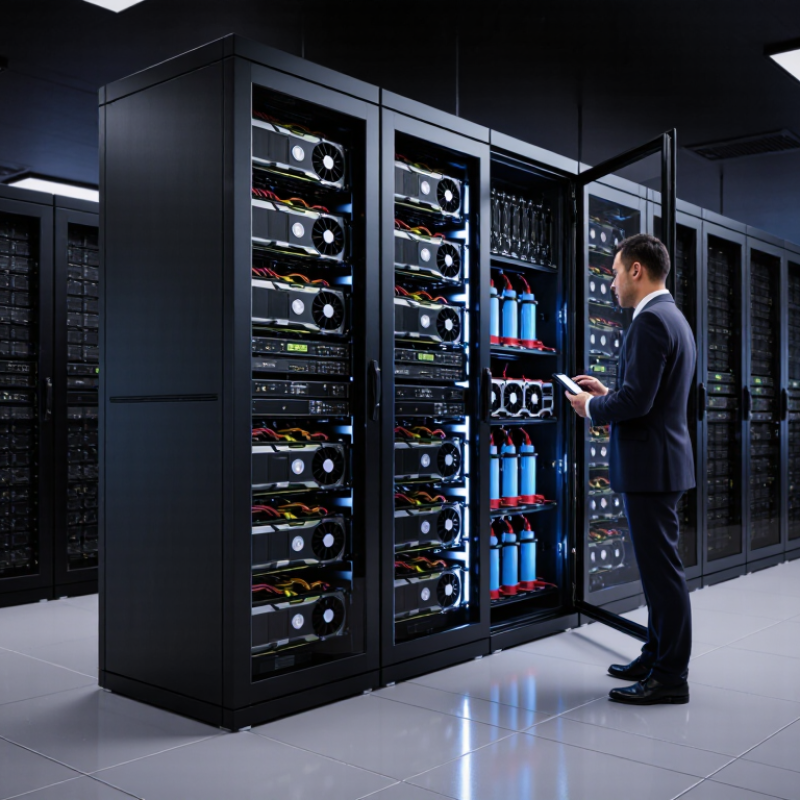
IDC projects that global AI spending could reach $632 billion by 2028. This growth will increase demand for reliable computing infrastructure, not just faster processors. AI workloads require dense GPU configurations, high memory bandwidth, stable networking, and careful thermal control. A specialized server manufacturer can design these elements as one system. That reduces integration errors inside a crowded data center rack.
In practical evaluations, performance is only part of the decision. Engineers should inspect power efficiency, cooling behavior, firmware stability, expansion options, and service response times. A server may deliver impressive benchmark results but struggle under continuous training loads. That difference matters. Real workloads often expose weaknesses that laboratory tests miss. No deployment is perfectly predictable, and even experienced teams may underestimate future storage or networking needs.
Tips: Request workload-based testing before purchase. Measure training time, power draw, fan noise, and recovery behavior. Check whether the manufacturer provides clear documentation, replacement planning, and long-term technical support. Ask for a realistic rack layout, including airflow and cable paths. Small details become expensive later. Independent validation also helps prevent decisions based only on attractive specifications. Choosing a manufacturer with engineering depth, transparent testing, and responsive support can make expanding AI infrastructure more manageable as demand accelerates.
| Data Dimension | Verified Figure | Time Frame | What It Means for AI Server Procurement | Reference |
|---|---|---|---|---|
| Worldwide AI and Generative AI Spending | Approximately US$632 billion | Projected for 2028 | Rapid market expansion increases the need for scalable, configurable, and serviceable AI computing platforms. | IDC, 2024 forecast |
| AI Spending Growth Rate | Approximately 29% compound annual growth | 2024–2028 | A manufacturer should support phased expansion, standardized configurations, and long-term component availability. | IDC, Worldwide AI and Generative AI Spending Guide |
| Generative AI Spending | Approximately US$202 billion | Projected for 2028 | Training and inference workloads require high memory bandwidth, fast interconnects, and efficient multi-node scaling. | IDC, 2024 forecast |
| Data Center Electricity Demand | About 460 TWh consumed globally | 2022 | Power efficiency, high-efficiency power supplies, and accurate workload power planning are essential when selecting a server platform. | International Energy Agency, Electricity 2024 |
| Potential Data Center Electricity Demand | More than 1,000 TWh in the high-growth case | By 2026 | AI server designs should offer power monitoring, efficient airflow, and compatibility with liquid-cooling options. | International Energy Agency, Electricity 2024 |
| Recommended IT Equipment Inlet Temperature | 18–27°C recommended range for common air-cooled equipment classes | Current data center guidance | Thermal validation, fan-control design, and cooling integration should be assessed before deployment. | ASHRAE Thermal Guidelines for Data Processing Environments |
| 80 PLUS Titanium Power Supply Efficiency | At least 94% efficiency at 50% load for 230V internal non-redundant supplies | Certification requirement | Higher power efficiency can reduce electricity waste and cooling requirements in dense AI deployments. | 80 PLUS performance specification |
| Server Lifecycle Planning | 3–5 years is a common enterprise planning horizon | Typical deployment cycle | A qualified manufacturer should provide firmware maintenance, spare parts, upgrade paths, and responsive technical support. | Common enterprise infrastructure planning practice |
Note: Figures are rounded where appropriate and refer to global market or industry-level data rather than any individual company or brand.
AI workloads need dense accelerators, high memory bandwidth, stable networking, and controlled cooling. A specialized manufacturer can design these parts together. That reduces integration mistakes inside crowded racks.
Request workload-based testing before purchase. Measure training time, power draw, fan noise, and recovery behavior. Laboratory benchmarks can miss problems during continuous training. Test real workloads.
One failed power module can interrupt training and delay customer services. Industry research reports that 54% of outages exceed $100,000 in impact. That figure deserves attention.
Look for redundant power supplies, efficient cooling, tested firmware, and clear fault monitoring. Ask how the system behaves under heavy workloads. Quiet laboratory testing is not enough.
Ask about spare-part locations, escalation procedures, maintenance records, and recovery targets. Confirm response times in writing. Vague promises create avoidable risk.
Request measured PUE data from different seasons. Check the measurement boundaries and operating conditions. A lower PUE may reduce electricity and cooling costs, but estimates can change after deployment.
Confirm bandwidth, latency, topology, and storage compatibility. Test east-west traffic before signing. A fast network on paper may slow under congestion.
Discuss firmware updates, security patches, hardware expansion, recycling, and technical training. Confirm that support engineers understand distributed AI workloads. References help, but they can be selective.
No. Even experienced teams may underestimate future storage, networking, or power needs. I would leave capacity room. Small omissions become expensive later.
The rapid growth of artificial intelligence is driving unprecedented demand for specialized computing infrastructure, with global AI spending projected to reach $632 billion by 2028. Advanced GPU systems can deliver nearly 3,958 FP8 Tensor TFLOPS, enabling faster model training, inference, and data processing. However, performance alone is not enough. Data-center power consumption is expected to double by 2026, making energy efficiency, thermal management, and scalable cooling essential considerations for organizations planning long-term AI deployments.
Choosing the right ai computing server manufacturer can help businesses balance performance, reliability, and operating costs. Buyers should compare power usage effectiveness, service-level agreements, network interconnects, hardware expandability, and lifecycle support. Strong maintenance programs are especially important because more than half of major outages can create losses exceeding $100,000. A capable manufacturer should therefore provide dependable systems, responsive technical support, efficient infrastructure designs, and upgrade paths that protect investment as AI workloads continue to evolve.

 Nexus AI Server